
If a camp is going to move, the unit decision changes. Three numbers decide it: how many units fit in one 40HQ container, how much work has to be repeated on site, and how much of the building arrives already sealed in the factory. Across Wanbang's four modular unit types those numbers differ enough to change the whole procurement plan.
This guide compares the four types specifically for camps that are expected to be dismantled and rebuilt — a second site, a third site, or an annual move between remote work fronts. It does not cover first-time installation, which is a different set of questions.
Two of the four are explicitly positioned that way in the product documentation, and a third is described as high-reusability and easy to relocate. The differences come from how much of the unit is factory-assembled before it ships.
Freight per unit is set on the first shipment and again on every move after it. The loading figures published for the four types are the ones to plan against.
| Unit type | Loading method | Units per 40HQ |
|---|---|---|
| Quick-assembly container house | Knock-down loading — panels, columns and accessories shipped as parts | Approximately 14 |
| Foldable container house | Pre-assembled loading — delivered folded, multi-layer stacking | Approximately 10 |
| Stackable quick-assembly unit | Pre-assembled loading — delivered folded, multi-layer stacking | Approximately 6 |
| Flat-pack container house | Sandwich packing — roof and base prefabricated in the factory, wall panels, columns and accessories assembled on site | See the loading plan for the specific unit and stacking arrangement |
The foldable unit compresses to roughly one-sixth of its original volume when folded. The practical trade is container slots against site hours: the foldable unit arrives closer to finished, so it carries 10 units per container, where the knocked-down unit carries about 14.
Per 40HQ: approximately 14 quick-assembly units, 10 foldable units, 6 stackable units. The same figure applies to each subsequent move, which is what makes container slots the dominant cost in a relocating camp.
Site labour is the second half of the relocation cost. Here the published data is specific for one type and structural for the others.
The unit ships as parts and is assembled with bolt fasteners throughout — no welding is required on site. The documentation states that a single unit can be installed by four workers in approximately three hours, and that no crane or forklift is needed. On a repeat move the same crew and the same absence of welding apply, which is what makes the type usable at sites without heavy lifting equipment.
Because columns and wall panels are pre-assembled and folded at the factory, the site operation is unfolding and positioning rather than rebuilding. There is no panel-by-panel assembly to repeat, which is the main reason the type is recommended for frequent relocation.
Wall panels arrive pre-installed, so on each move the site work is limited to setting columns and roof panels and locking the unit together. The documentation places the type between the flat-pack and the foldable unit in both assembly difficulty and build speed.
A unit that is dismantled twice has already survived two handling cycles before it is even reused. The components that decide whether it survives a third are the frame, the panels and the floor.
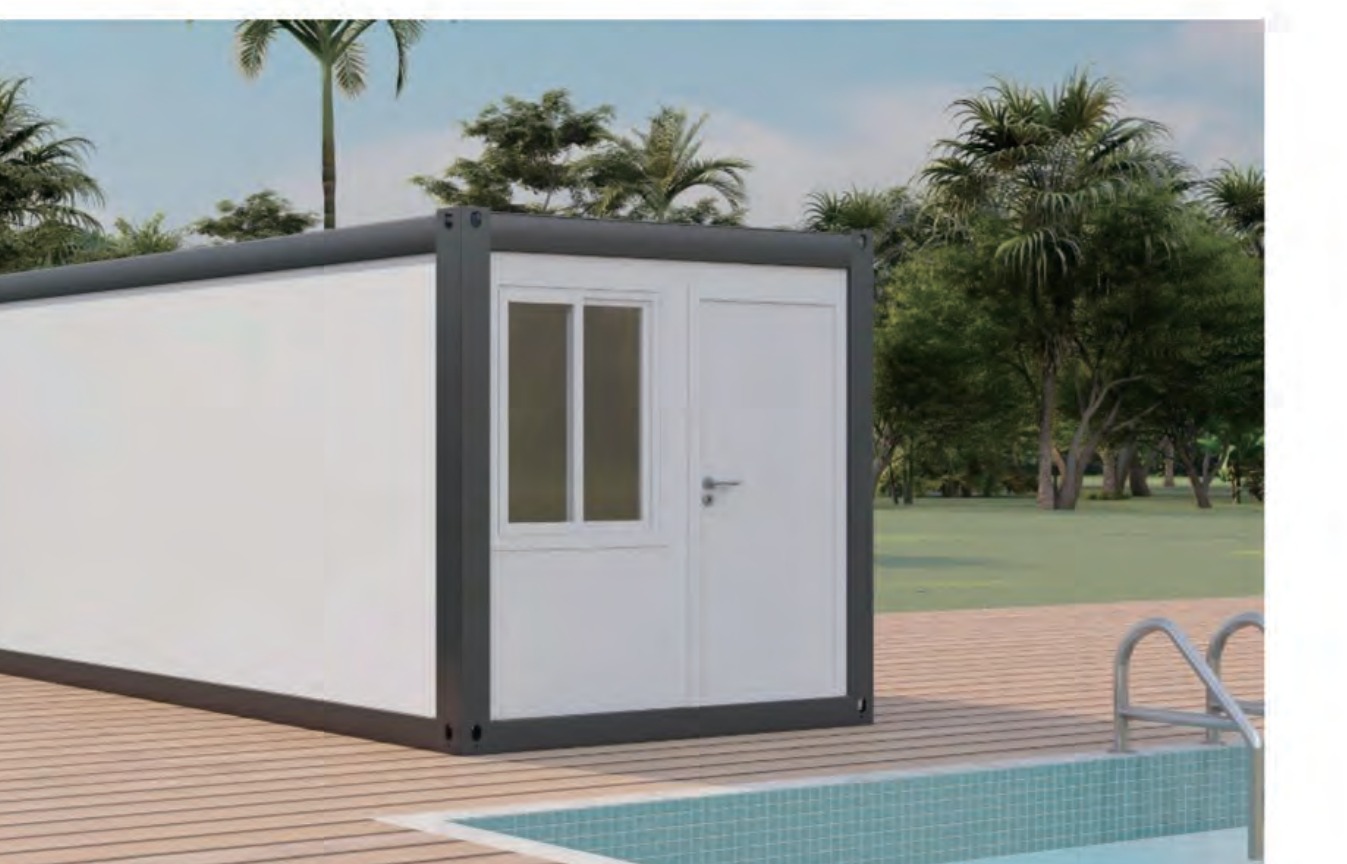
High-strength galvanized steel frame — columns, top beams and bottom beams. Walls are colour-steel rock wool sandwich panels, offering thermal insulation, fire resistance and moisture resistance.
Cement fibre board with PVC flooring for load-bearing capacity, fire resistance and slip resistance; steel components use a baked-enamel finish documented as fade-resistant for up to five years.
Two practical points follow from this. Concealed wiring and the centralized organised internal drainage system are factory-installed, so on each move the electrical and drainage connections are the last items to re-commission rather than the first to rebuild. And because the flat-pack unit is documented as high-reusability and easy to hoist, transport and relocate, the hoisting method matters as much as the unit type: a poorly balanced lift damages panels that would otherwise serve another cycle.
An honest boundary: the product documentation does not publish a maximum number of relocation cycles for any of the four types. The usable limit is set by the condition of the frame, panels and flooring at each teardown, so the second move is the point at which to record what was replaced.
| If the camp will… | Unit type to plan around | Why |
|---|---|---|
| Move between work fronts every year or so | Foldable container house | Pre-assembled and folded at the factory; no panel-by-panel rebuild; 10 units per 40HQ |
| Sit for a long period, with one possible re-siting | Quick-assembly container house | Lowest freight per unit at 14 per 40HQ; bolt assembly, no welding, no crane or forklift |
| Need offices, meeting rooms and a better finish alongside dormitories | Flat-pack container house | Better finish and the widest set of camp functions; documented as high-reusability and easy to relocate |
| Occupy a site too small for single-storey rows | Stackable quick-assembly unit | Multi-layer stacking after folding; 6 units per 40HQ; panels pre-installed |
Most relocating camps end up mixed. Volume dormitories on the quick-assembly type keep freight per bed down, while the administration and canteen blocks use units with a higher finish level. The mix is decided per site, and it should be fixed before the first shipment because it sets the container count for every move that follows. For the loading side of that calculation, see our guide to how many container houses fit in a 40ft container.
The foldable container house, because its columns and wall panels are pre-assembled in the factory and it is delivered folded — the site operation is unfolding and positioning rather than rebuilding. The stackable quick-assembly unit is positioned for the same frequent-relocation use, with wall panels pre-installed and columns and roof fitted on site.
Approximately 14 quick-assembly units, approximately 10 foldable units and approximately 6 stackable units. The flat-pack unit ships by sandwich packing, with the roof and base prefabricated in the factory, so its loading figure is planned per unit and stacking arrangement.
No. The quick-assembly unit is assembled entirely with bolt fasteners and requires no welding; the documentation states that four workers can install one unit in approximately three hours without a crane or forklift.
The foldable and stackable types are documented as suited to frequent relocation, and the flat-pack unit as high-reusability and easy to hoist, transport and relocate. The documentation does not state a maximum number of relocation cycles, so the practical limit is the condition of the frame, panels and flooring recorded at each teardown.


 IPv6 RÉSEAU PRIS EN CHARGE
Hi! Click one of our members below to chat on
 Français
 English
 Deutsch
 Русский
 Italiano
 Español
 Português
 Türk
Türk Ελληνικά
 Indonesia
 عربي
عربي


